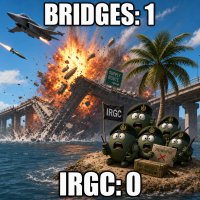
Nothing says "diplomacy has left the building" quite like six consecutive nights of airstrikes, and the United States is apparently just getting warmed up. As Trending Politics reported, the U.S. escalated its air campaign against Iran early Friday, hammering bridges, roads, and what appears to be a surveillance tower at a key Iranian port as President Trump made good on promises to go after Tehran's infrastructure.
The goal here is pretty straightforward: choke off the Islamic Revolutionary Guard Corps by cutting the transportation arteries that connect Iran's largest port, Bandar Abbas, to the rest of the country. Highway bridges, railway bridges, the works. If it connects point A to point B and the IRGC might use it, it apparently got a visit from the U.S. Air Force.
Iran, for its part, responded the way Iran has been responding: by launching another wave of missiles at U.S. allied nations in the Middle East, including Qatar. Yes, Qatar, the country that has been trying to mediate this whole mess. That is one way to thank your mediator.
The fragile ceasefire from last month is now officially in the rearview mirror. When the U.S. and Israel kicked off military operations against Iran back on February 28, Tehran shut down shipping through the Strait of Hormuz, which sent oil prices into the stratosphere and handed the regime a big bargaining chip. Now both sides are locked in a back and forth over control of the waterway, and neither appears interested in blinking.
Overnight strikes hit the coastal city of Bandar Khamir in Hormozgan province, killing at least seven people according to Iranian state television. Iranian officials claim American strikes throughout the conflict have killed dozens and wounded hundreds.
President Trump, during a primetime address, sounded characteristically optimistic about how things are going. "We are likewise winning big in Iran, and you will see the fruits of that labor very, very shortly," Trump said.
U.S. Central Command confirmed the latest operation struck dozens of targets before wrapping up at dawn Friday. Among the apparent casualties of the evening was a surveillance tower at Iran's Chabahar port on the Gulf of Oman. Iran's state news agency IRNA confirmed the port was hit for a third time during the conflict but did not immediately acknowledge the tower's collapse. Defense Secretary Pete Hegseth shared an image of the tower apparently going down, though by that point the picture had already been making the rounds on social media. Classic move: post the viral content after it already went viral.
Iran described the tower as a tool for monitoring commercial shipping traffic. The Pentagon is presumably skeptical of that characterization, given that the IRGC maintains a presence at ports across the country. A surveillance tower at a port where the Revolutionary Guard hangs out could be monitoring a lot more than cargo ships, which is probably why it no longer exists.
Alternate routes to Bandar Abbas reportedly remain open for now, but with the U.S. apparently working through a checklist of Iranian infrastructure, "for now" is doing a lot of heavy lifting in that sentence.
Read more breaking news stories at: Trending Politics News