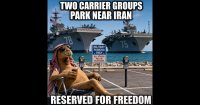
Nothing says "we need to talk" quite like parking two aircraft carrier strike groups in your neighbor's driveway. The United States has repositioned the USS Abraham Lincoln and USS George H.W. Bush carrier strike groups into the Gulf of Oman, with more than 20 Navy warships spread across Middle East waters, as Trending Politics reported based on maritime tracking data. President Trump is reportedly mulling the reimposition of a naval blockade on Iranian ports, because apparently sanctions alone just were not sending a strong enough message.
The naval flex comes after Iran decided to test the boundaries of a fragile ceasefire agreed to back in April by attacking multiple commercial vessels in the Strait of Hormuz between July 5 and 6. For those keeping score at home, attacking commercial ships is generally considered a violation of a ceasefire, not to mention the subsequent Islamabad memorandum. Iran really looked at the agreement and said "nah."
The United States responded with the subtlety of a sledgehammer, striking more than 80 Iranian targets. The hit list included air defense systems, command and control networks, coastal radar sites, anti-ship missile capabilities, and over 60 Islamic Revolutionary Guard Corps small boats near the strait. That is not a proportional response. That is a spring cleaning.
On top of the military strikes, the administration revoked waivers that had been allowing Iranian oil sales and slapped sanctions back into place. Trump, speaking at the NATO Leaders' Summit, declared the interim ceasefire agreement was over and described further dealings with Iran as unproductive. But he also noted that the U.S. had agreed to keep talking after Iran requested continued discussions. Classic breakup energy: "This is over, but sure, let's keep texting."
U.S. Central Command confirmed the 20-plus warship presence on July 8 but declined to get into specifics about operational plans, citing security considerations. Meanwhile, the USS Abraham Lincoln was spotted sailing north through the Gulf of Oman without visible escort warships, which is either a bold power move or someone in the fleet forgot to buddy up.
Retired Rear Adm. Mark Montgomery, a senior fellow at the Foundation for Defense of Democracies, pointed out that naval assets typically scoot closer to operational areas when preparing for blockade enforcement or supporting commercial transits through the Strait of Hormuz. So this is either preparation for a blockade or the world's most expensive cruise.
Diplomacy has not completely evaporated. A Qatari delegation wrapped up talks in Tehran on July 10 aimed at de-escalation, conducted in coordination with Washington. Iranian Foreign Minister Abbas Araghchi then traveled to Oman on July 11 for discussions on safe navigation through the strait. U.S. officials have made it clear that Iran needs to stop attacking commercial shipping and keep the transit lanes open, which feels like a reasonable ask when your entire argument is backed by two carrier groups.
The big question now is whether diplomacy wins out or whether we are about to see a full blockade reinstated. Either way, Iran is running out of room to negotiate from a position of strength when the other side brought 20 warships to the conversation.
Read more breaking news stories at: Trending Politics News