Hold onto your seats, because one of the biggest terrorism lawsuits in American history just hit a turning point that nobody on the losing side wanted to see.
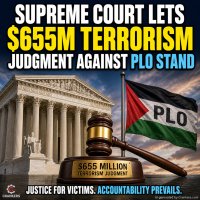
The U.S. Supreme Court just refused to block enforcement of a staggering $655 million judgment against the Palestine Liberation Organization and the Palestinian Authority, Conservative Brief reported. Not a single justice publicly dissented. Let that sink in. The Palestinian defendants threw a Hail Mary emergency request at the highest court in the land, begging for a stay while they scrambled for additional legal options. The justices essentially looked at that request and said, "Nah."
So how did we get here? Buckle up, because this legal saga spans over a decade.
American citizens and their families filed suit under the Anti-Terrorism Act after a series of horrific bombings and shootings carried out in Israel between 2002 and 2004 during the Second Intifada. The plaintiffs argued that both the PLO and the Palestinian Authority provided financial and operational backing to the terrorist organizations that executed those attacks.
A federal jury sitting in Manhattan agreed with every word of it. They slapped the defendants with $218.5 million in compensatory damages. But here is where it gets absolutely wild. Under the Anti-Terrorism Act, those awards get automatically tripled in terrorism cases. That bumped the total to roughly $655 million.
Now, the defendants did not go quietly. They fought tooth and nail on jurisdictional grounds, and at one point they actually won. The Second Circuit Court of Appeals tossed the entire verdict, ruling that these Palestinian entities lacked enough connections to the United States to justify American courts hearing the case.
Then Congress stepped in with a massive power move. Lawmakers amended the Anti-Terrorism Act to broaden jurisdiction over foreign organizations accused of backing terrorist operations. After that legislative change, the Second Circuit reversed course and reinstated the full judgment, shooting down constitutional challenges to the updated law.
The defendants tried the normal Supreme Court appeals route first. Denied. Then came that emergency application to freeze enforcement. Also denied.
So what happens next? Lawyers for the victims can now start hunting for assets to seize. But here is the catch that could rain on this parade. Collecting terrorism judgments against foreign entities has historically been an absolute nightmare. Both the PLO and Palestinian Authority reportedly hold very few assets within reach of American courts. Recovery efforts could require grueling additional litigation both domestically and overseas.
Still, this ruling sends a thunderous message. Congress has clearly expanded the legal toolkit available to American terrorism victims, and the Supreme Court is not standing in the way.
This case also lands during a period of intense global attention on the Israeli-Palestinian conflict and fierce debate over financial support flowing to Palestinian governing bodies.
Whether these families ever see a dime of that $655 million remains a massive open question. But for now, the law is firmly planted on their side.
Like what you see? Then sign up for our Free Newsletter