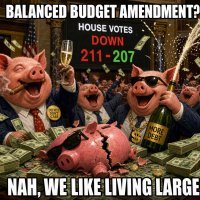
The U.S. House of Representatives voted down a balanced budget amendment on Tuesday, because apparently the idea of not spending more money than you have is just too radical a concept for modern governance. As Conservative Brief reported, lawmakers rejected the resolution 211 to 207, with nearly every Democrat voting against it and only one lonely Democrat crossing the aisle to support it.
The amendment, sponsored by Rep. Andy Biggs of Arizona, would have kicked off the process of actually amending the Constitution to prohibit deficit spending. It needed a two-thirds majority in both chambers before heading to the states for ratification, which meant it was facing roughly the same odds as a snowball surviving a July afternoon in Phoenix.
Biggs seemed genuinely surprised the vote even happened, describing a call from leadership that came out of nowhere. "Many of us have been agitating for years to do a balanced budget amendment, and out of the blue, they said, 'we're ready to do it,'" Biggs said. "They didn't ask me to do anything, didn't offer anything. Just out of the blue, I got a call." Nothing says congressional efficiency like decades of advocacy followed by a surprise phone call.
For the record, balanced budget amendments have been introduced more than 100 times since 1999, according to legislative data analyzed by the Pew Research Center. Over a hundred attempts and counting. At this point it is less a legislative priority and more of a congressional tradition, like naming post offices or pretending to read bills before voting on them.
The specifics of Biggs' proposal were actually pretty detailed. Federal spending in any given year could not exceed the average annual revenue collected over the previous three years, adjusted for inflation and population growth. There was a war exception, but only for formally declared wars. Since the United States has not formally declared war since World War II, that exception is about as useful as a screen door on a submarine. Every major military conflict since then has been funded through deficit spending without a formal declaration.
The proposal also would have required a two-thirds vote in both chambers for any new taxes or tax increases, up from the simple majority currently needed under procedures like budget reconciliation. So basically it was asking Congress to make it harder to both spend money and collect money. Bold strategy.
Supporters argue a balanced budget requirement would impose much needed discipline on federal spending. Opponents counter that it would hamstring the government's ability to respond to economic downturns or emergencies. Both sides have a point, which is probably why this debate has been going on since the 1970s with no resolution in sight.
The House did manage to pass something the very next day: the Deporting Fraudsters Act, which would classify fraud involving public benefits as a deportable offense. That one passed 231 to 186. "If you admit to or you're convicted of fraudulently receiving public benefits, you are out of here on the next plane and can never return," said Rep. Tom McClintock of California. Democrats argued existing law already covers this, making the bill unnecessary. So Congress spent two days voting on things that either cannot pass or allegedly already exist. Productive week all around.
Like what you see? Then sign up for our Free Newsletter