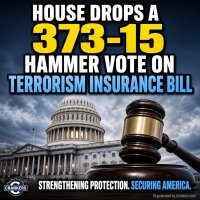
Congress just pulled off something that barely ever happens anymore: a genuinely lopsided bipartisan vote. The House of Representatives absolutely steamrolled through legislation extending the federal Terrorism Risk Insurance Program all the way to 2034, and the final tally was a jaw-dropping 373 to 15, as Conservative Brief reported. That kind of margin in today's political climate? Almost unheard of.
So what exactly got nearly every lawmaker on the same page? It all comes down to H.R. 7128, officially known as the TRIA Program Reauthorization Act of 2026. Rep. Mike Flood, a Nebraska Republican who chairs the Housing and Insurance Subcommittee under Financial Services, sponsored this thing. And now it rockets over to the Senate for the next round.
Here is the wild part that nobody talks about enough. This program was born out of the horrific September 11, 2001 terrorist attacks, and in its entire existence, not a single claim has ever been paid out. Zero. Zilch. Nada. Flood himself pointed that out during debate, saying he hopes the program never has to cut a check. But he argued that if taxpayers are going to serve as the ultimate safety net, the rules need updating.
And updates they got. The bill bumps up the minimum insured losses required to certify an act of terrorism from $5 million to $10 million starting in 2029. Translation: the bar for triggering federal involvement just got significantly higher. The legislation also gives the Treasury Department clear legal authority to publicly explain how it determines whether something qualifies as terrorism under the program.
Rep. French Hill, the Arkansas Republican who chairs the full Financial Services Committee, laid out exactly why this matters during floor debate. He stressed that the program gives businesses the confidence to construct skyscrapers, operate sports venues, and build shopping centers. Without that federal backstop, insurers could bail on offering terrorism coverage altogether, potentially leaving major cities and high profile locations scrambling.
The business lobby is absolutely loving this. Both the U.S. Chamber of Commerce and the American Bankers Association threw their weight behind reauthorization. Their argument is simple: predictable terrorism coverage keeps commercial real estate lending flowing, construction projects moving, and large venues operating. Millions of jobs across construction, property management, retail, and hospitality depend on this stability.
Analysts have been sounding alarms about what happens if the program lapses at the end of 2027. Without it, insurers might pull back dramatically, driving costs through the roof or making coverage impossible for businesses in metropolitan areas.
Supporters are calling the updates smart taxpayer protections that keep the program's fundamental purpose intact while raising the threshold for government participation. A companion bill already exists in the Senate, so this thing could be on the fast track to becoming law. Stay tuned, because 373 votes in the House is the kind of momentum that is hard to stop.
Like what you see? Then sign up for our Free Newsletter