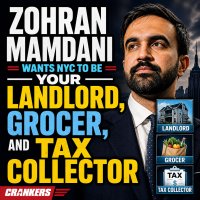
New York City's socialist mayor wants to sell you cheap bananas with your own money.
Zohran Mamdani has committed $70 million of taxpayer funds to build five government-owned grocery stores across the city, promising prices roughly 30% lower than comparable retailers. The first location is slated to open in Hunts Point by the end of 2027, with additional spots planned for East Harlem, Brooklyn, Queens, and Staten Island. Economists and small business advocates are already sounding alarms, as according to reports, the whole arrangement could stick taxpayers with the bill not once, but twice.
Here's how this beautiful fever dream works. The city provides real estate at little or zero cost. It pays for construction. It absorbs massive occupancy expenses. Then private operators come in to handle staffing and sourcing while City Hall dictates pricing requirements and operating standards. So basically the government is playing landlord, financier, and referee all at once. What could possibly go wrong.
E.J. Antoni, chief economist at the Heritage Foundation, did some very basic math that apparently eluded the mayor's office. Supermarkets typically survive on a 2% profit margin. Mamdani is promising a 30% discount. Antoni pointed out that this gap is "simply a loss for taxpayers who will have to make up the difference." He also noted these artificially suppressed prices will siphon customers away from small businesses that actually pay rent and taxes like normal earthlings.
Adam Lehodey from the Manhattan Institute was equally unimpressed. He called the promised 30% savings "an illusion," noting that New Yorkers will still cover the full cost of groceries, just through their tax bills instead of at the register. Lehodey also raised the delightful possibility that people might buy cheap subsidized goods and resell them elsewhere for profit. Government discount arbitrage. A truly modern hustle.
Then things got even more awkward. Someone floated the idea that the city might need to offer grants to existing private grocers so they could compete against the government stores that are undercutting them with taxpayer subsidies. The Economic Development Corporation quickly walked that back, telling reporters the Grocery Task Force "is not currently considering any grant programs for existing grocers." The phrase "not currently" is doing some Olympic-level heavy lifting in that sentence.
The $70 million covers just the five planned locations. The administration has provided zero estimates for what ongoing subsidies might eventually cost if these stores keep selling food well below market prices for years on end. That's the financial equivalent of jumping out of a plane and planning to figure out the parachute situation on the way down.
For the city's independent bodegas and supermarkets, the situation is especially grim. They could soon be competing against stores whose landlord, banker, and regulatory overlord is the same government entity collecting their taxes. That's not a level playing field. That's a vertical cliff.
Mamdani argues struggling New Yorkers need alternatives to soaring food costs. Critics counter that eliminating rent for a store doesn't eliminate rent from existence. It just transfers the expense to everyone with a tax bill. The groceries might look cheaper at checkout, but the receipt shows up in April.
Like what you see? Then sign up for our Free Newsletter