Hold onto your seats, because the legal battle over Charlie Kirk's assassination just got even more intense.
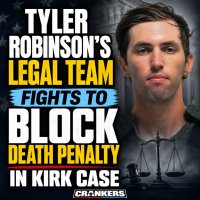
Lawyers for Tyler Robinson, the 23-year-old accused of gunning down the Turning Point USA founder, are now begging a Utah judge to completely eliminate capital punishment from the table. As reported, the defense team dropped a massive 41-page brief arguing that prosecutors simply cannot prove the one aggravating factor needed to keep lethal injection on the menu.
Here's the crux of their argument. Robinson's attorneys, Kathy Nester, Michael Burt, Richard Novak, and Staci Visser, say the state must demonstrate that the shooting posed a significant risk of killing someone besides Kirk, and that Robinson knew about that danger. The defense says neither condition has been satisfied.
Let's rewind to what allegedly happened. On September 10, 2025, Kirk was addressing over 2,000 people at a Turning Point USA gathering held at Utah Valley University. A single bullet struck him in the neck, ending his life in front of a horrified crowd. The nation was rocked by the brazen killing of one of conservatism's most visible young leaders.
So how does Robinson's legal squad plan to dodge the ultimate punishment? They're laser-focused on bullet trajectory. According to their filing, the round was launched from a rooftop position and traveled above the assembled audience rather than slicing through it. Only one shot rang out, they emphasize, and it hit nobody except Kirk.
The recovered weapon also plays into their strategy. A bolt-action Mauser rifle chambered in .30-06 was found alongside a single spent casing and three live rounds. Defense lawyers frame this as proof of a calculated, singular target, not some reckless spray into a crowd.
Then there's the messaging evidence. Prosecutors introduced communications between Robinson and an associate named Lance Twiggs. One text allegedly sent by Robinson states he recognized an opportunity to eliminate Kirk and seized it. His lawyers actually lean into this, arguing the language proves Robinson cared exclusively about one person and never threatened anybody else.
The defense also pushes back on the prosecution's theory that Kirk's political views motivated the attack. They challenge the state's attempt to connect Robinson's personal relationships with Twiggs to some ideological grudge against Kirk's positions on cultural topics. That inferential leap simply doesn't hold up, they argue.
Prosecutors see things very differently, of course. Their position is that firing a weapon into a packed university courtyard with thousands of civilians present inherently created enormous danger. Surveillance footage allegedly captures the shooter approaching a sniper's perch overlooking the venue.
This marks the second time Robinson's team has tried to neutralize the possibility of execution. Their earlier attempt, based on a prosecutor being held in contempt for public remarks, was swatted down by Judge Tony Graf Jr. as a wildly disproportionate remedy.
Now everything hinges on whether sufficient probable cause exists to advance toward trial. Judge Graf is expected to rule within weeks, and prosecutors have until next week to fire back with their response.
For those who viewed Kirk's murder as a devastating blow to free speech and conservative activism, these courtroom maneuvers feel like legal gymnastics designed to soften accountability for a political assassination carried out in broad daylight. Utah County prosecutors remain firmly committed to pursuing the harshest possible sentence if Robinson faces conviction.
Like what you see? Then sign up for our Free Newsletter