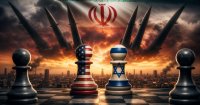
Whatever fragile diplomatic progress may have existed between the United States and Iran appears to be crumbling fast. While one faction of the Iranian government continues to discuss a potential peace deal, the country's most powerful religious body has taken a sharp and dangerous turn in the opposite direction, as USA Journal reported this week.
Iran's Assembly of Experts, an 88-member body of senior clerics constitutionally responsible for selecting and overseeing the supreme leader, issued a 10-point statement declaring that killing President Donald Trump and Israeli Prime Minister Benjamin Netanyahu is a religious obligation. The statement labeled both leaders as mahdour al-dam, meaning deserving of death, and described the assassinations as duties that must be carried out "under any circumstances." The clerics framed the directive partly as vengeance for the death of Supreme Leader Ali Khamenei.
Speaking of Khamenei, his current status remains a mystery. There has been no confirmation that he is functioning, coherent, or even alive. The silence is deafening, and it raises serious questions about who is actually steering the ship in Tehran.
The Islamic Revolutionary Guard Corps continues to behave as if it is running the show, launching attacks on shipping in the Strait of Hormuz and carrying out strikes against neighboring countries. The so-called civil government, or what's left of it, keeps talking about diplomacy. These contradictions paint a picture of a regime at war with itself.
The threats aren't limited to clerical proclamations either. Iranian newspaper Hamshahri ran a front page featuring Trump's face in the crosshairs of a rifle scope, accompanied by the headline "Revenge is certain." It's the kind of provocation that might be easy to dismiss as bluster from a regime that has long talked tougher than it acts. But dismissing it would be a mistake.
Multiple real assassination attempts have already been made against Trump. The first one, carried out by an amateur, came within an ear's length of killing him. An attempt backed by a nation-state, even a weakened one like Iran, would look nothing like those earlier incidents. Trained operatives working in coordinated teams of two or three, possibly with multiple shooters, represent a fundamentally different level of threat.
The numbers compound the concern. An estimated 20,000 to 30,000 Iranian nationals are currently in the United States illegally, the vast majority having entered across the southern border during the Biden administration's years of lax enforcement. If even one percent of those individuals are operatives who infiltrated the country while the border was effectively open, that represents 200 to 300 potential hostile actors on American soil. That's roughly a reinforced infantry company, more than enough to cause serious problems.
The Secret Service and Netanyahu's security detail should be treating this threat with the utmost seriousness. What the mullahs may not fully grasp is the consequence of success. If Iranian operatives were to carry out an attack on the President of the United States, and if that attack could be traced back to Tehran, the response would be devastating. The United States possesses a capacity for military retaliation that no other country on earth can match.
But rational calculations of self-preservation may not apply here. The faction issuing these calls appears to view martyrdom not as a cost but as a reward. That makes them unpredictable, and unpredictability in a regime with access to military resources and a global network of operatives is a genuinely frightening combination.
Peace talks, such as they were, now look like little more than a fig leaf stretched over a regime that is fracturing along ideological fault lines. One side negotiates while the other calls for assassinations. It doesn't take a foreign policy expert to see where this is heading.
Read more conservative news commentary at: USA Journal News